
$GNRC [Generac]: Can Lightning Strike Twice in the Same Place?
The money flowing into AI does not stay inside the chip companies. It leaks—sometimes in a trickle, sometimes in a flood—into corners of the economy that have little to do with semiconductors. I showed one version of this with $FLS [Flowserve] last year (here), and another in July with $MLKN [MillerKnoll] (here), where spending on computers and peripheral equipment was running close to 70% above its level a year earlier. That money, I wrote then, is a story about boxes going into buildings. Today I want to follow those boxes one step further. Every one of those buildings must keep the boxes running when the grid fails—and that has turned the company best known for the generator humming behind suburban houses, $GNRC [Generac], into an AI supplier.
The first strike
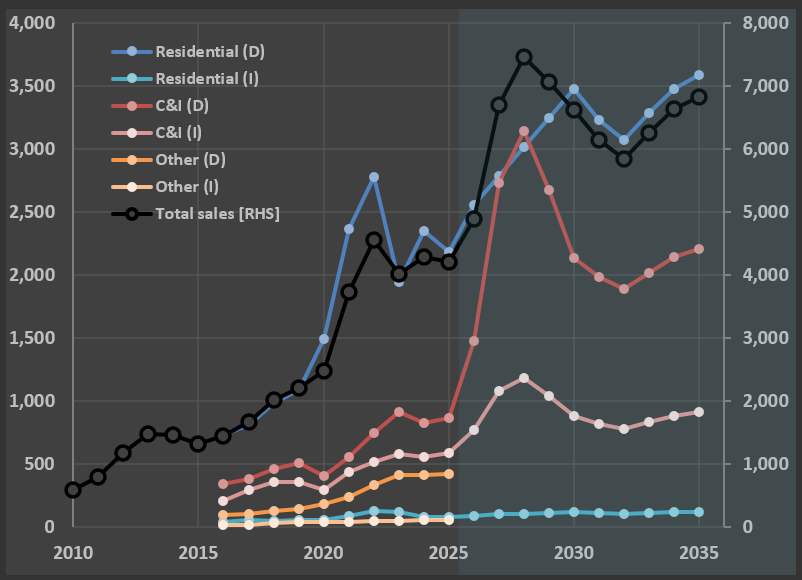
The first chart shows Generac’s sales by segment. The darker area is history; the lighter one is RIM’s explicit forecast. “(D)” stands for domestic and “(I)” for international; the black line is total sales, on the right-hand scale. For most of the company’s history, the story was the residential segment in the US (dark blue)—home standby generators, overwhelmingly. Commercial & Industrial (C&I, in red) was a smaller and much sleepier business.
Then came 2020–2022. Residential sales more than doubled between 2019 and 2021 and peaked near $2.8 billion in 2022, before falling roughly 30% the following year. There was more than one cause. The pandemic sent people home—to work, to study, to spend—and produced a mini-boom in housing construction. And then, in February 2021, Winter Storm Uri froze Texas. Millions of households lost power for days, in the middle of a pandemic, with people already confined to their homes and in a fragile frame of mind. An expensive standby generator became an impulse buy. Anyone in the Northeast who lived through Sandy will recognize the reflex: the neighbor who didn’t have a generator orders one the week the lights come back on.
They say lightning never strikes twice in the same place. Generac—a company whose entire business is selling insurance against what storms do to power lines—might be about to prove the saying wrong.
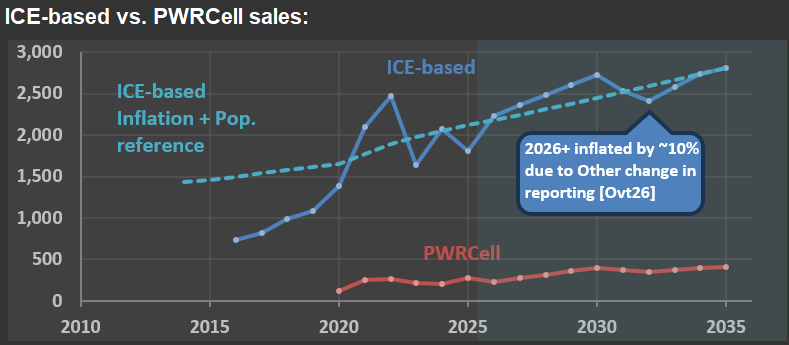
Before getting to the second strike, one observation about the first: it left a permanent mark. The second chart isolates Generac’s engine-based residential products (essentially its standby and portable generators) and sets them against a reference line that grows only with inflation and population (dashed). Before the pandemic, sales ran 30%–50% below that line. Since then, they have stayed within shouting distance of it—even in the 2023 hangover, and even in 2025, a year with unusually few power outages. In late 2022, my base case assumed sales would drift back toward their 2019 level, once adjusted for inflation and population. They haven’t: more people working from home, more gadgets, and more electrification—EVs included—appear to have raised the baseline for good. Some impulse buys become habits. (The red line, by the way, is PWRCell, Generac’s home-battery business—still small, as I expected it would be. And the forecast portion of both charts is inflated by about 10% due to a change in how Generac reports its “Other” sales.)
The second strike
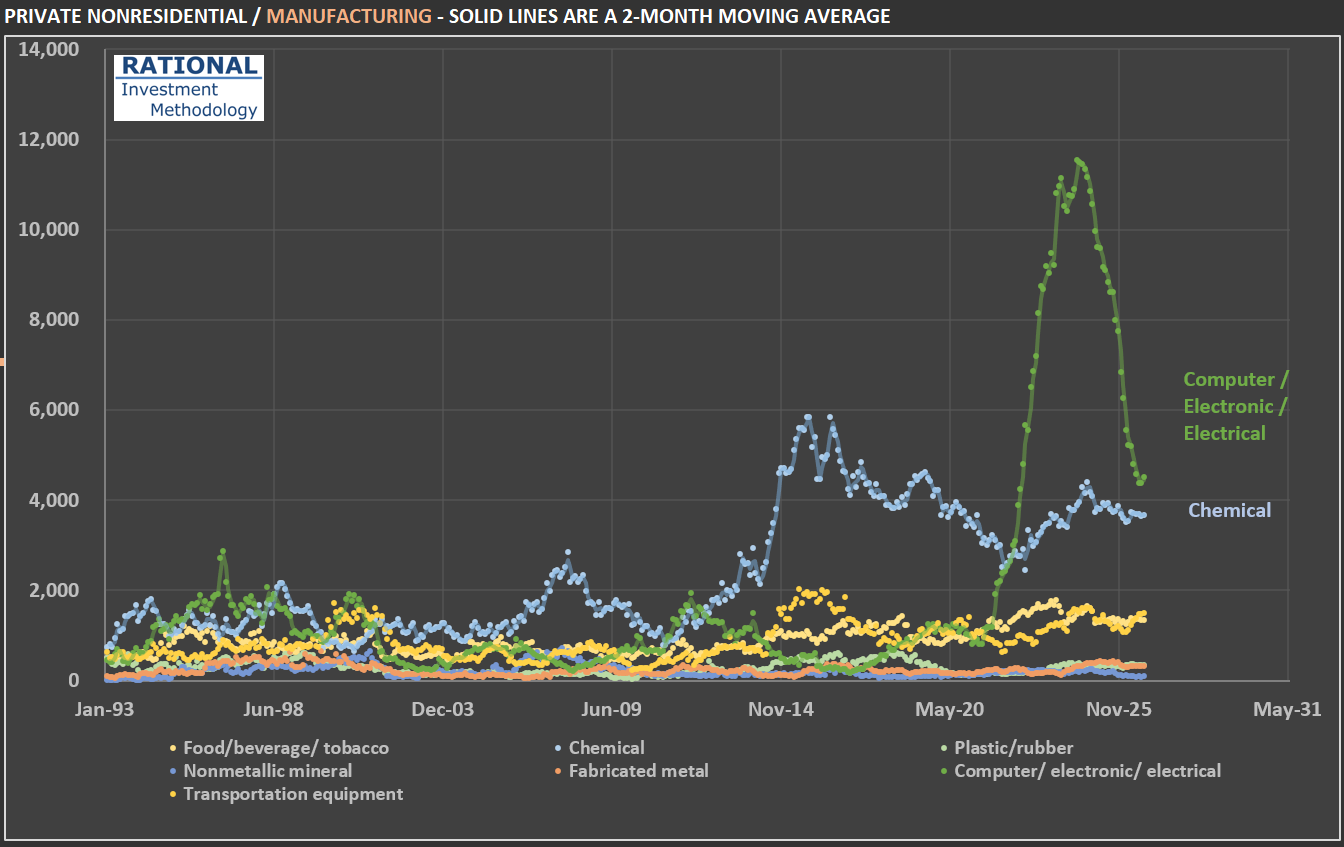
Back in March, I split US construction spending into finer subcategories (here). The two charts below are the same ones, updated (as before, figures are adjusted for inflation and population).
On the manufacturing side, the CHIPS-Act-fueled spike in Computer/Electronic/Electrical plants is unwinding fast—down about 60% from its peak. That is the shape I described then: a policy-driven wave of mega-projects rolling off as they move past the heavy-construction phase.
On the office side, the opposite. Data center construction now runs above $7.5 billion a month, up from roughly $4.5–5 billion when I wrote that post, and almost twice what is being spent on “General” office buildings.
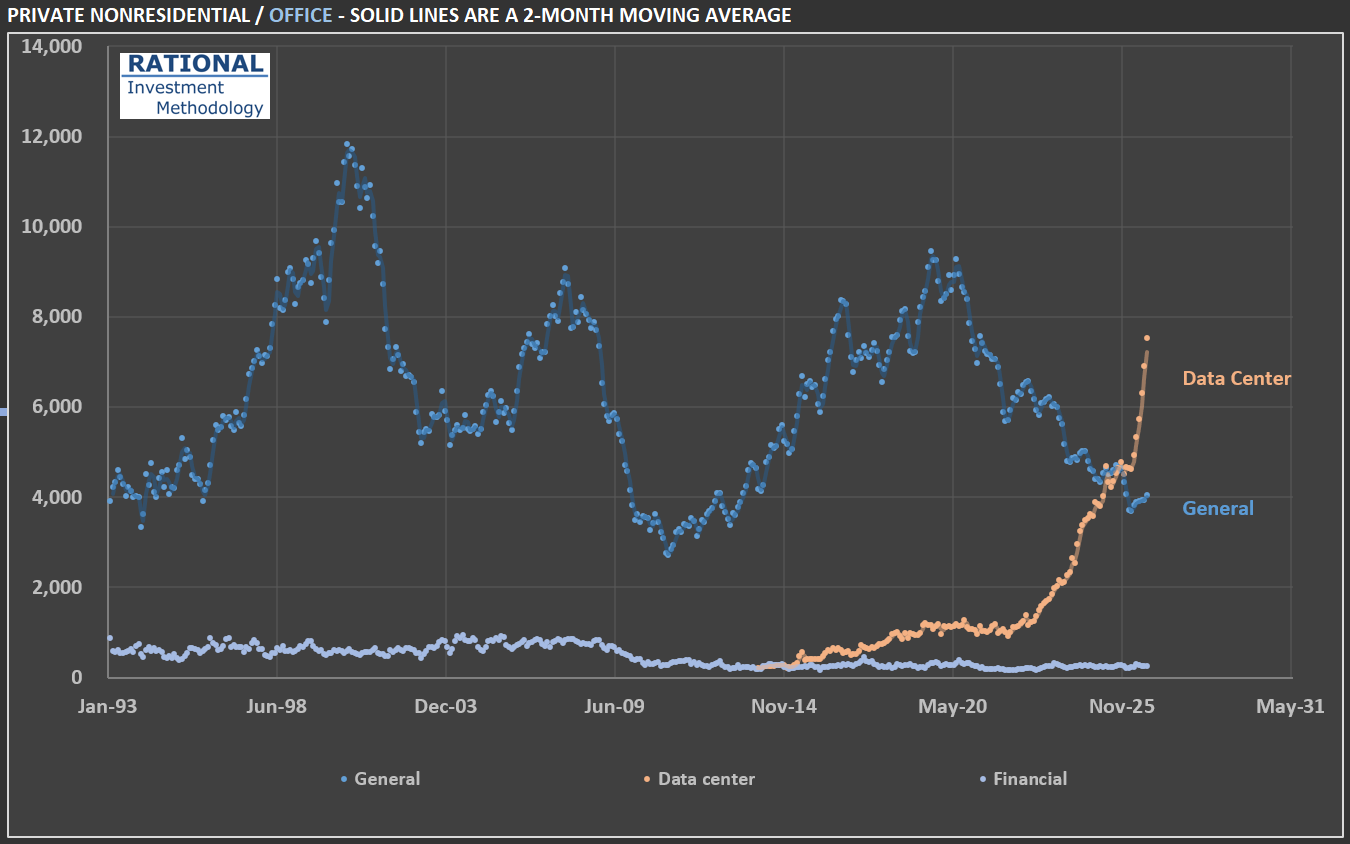
In that same post, I noted that data centers were barely above 2% of all US construction spending (roughly 4% today), and in April I used that fact to question Vulcan Materials' data-center enthusiasm (here): for aggregates, data centers are a story, not a number. For backup generators, it’s exactly the opposite. The reason lies in what a generator is asked to do inside a data center.
Why data centers need so many generators
In an office building, a generator keeps the exit lights, fire pumps, and elevators running—life safety, and little else. A hospital backs up its essential systems. A data center backs up everything: every server, every switch and—crucially—all of the cooling, because servers overheat within minutes without it. When the grid fails, batteries carry the servers for the few seconds it takes the generators to start; the generators must pick up the load within about ten seconds and then run the entire facility, servers included, for as long as the outage lasts. Hours, if needed. The design standards for high-reliability facilities go as far as treating the generator, not the utility, as the primary power source—the grid is merely the cheaper one. On top of that, customers typically specify 100%–130% of the facility’s load, plus spare units (N+1), or even a fully duplicated system (2N).
None of this is theoretical. In July 2024, a transmission fault knocked 60 data centers in Northern Virginia—roughly 1,500 MW of load—onto their backup systems, and that load didn’t return to the grid for hours (here). Northern Virginia alone now hosts more than 4,000 data center diesel generators with over 11 GW of capacity—more than the local utility’s entire gas-fired fleet (here).
The table below translates this into construction dollars:
| Building type | Power density (W/sq ft) | What runs on generators | Generators as a share of construction cost |
|---|---|---|---|
| Data center | 150 to 1,000+ | Everything (servers + cooling), at 100%–130% of load, often with N+1 or 2N spares | ~3%–8% |
| Hospital | 15–25 | Essential systems: a large share, rarely all | ~0.5%–1% |
| Office | 5–10 | Life safety only (egress lighting, fire pumps, elevators); many have none | ~0%–0.2% |
| Manufacturing / warehouse | Highly variable | Usually critical processes only | ~0.1%–0.5% |
A word of caution: the data center row is built from sourced inputs (cost per MW of capacity, cooling overhead, coverage ratios, and price per kW), while the other rows are orders of magnitude based on typical engineering ranges, not published statistics. But the gap is wide enough that precision hardly matters: per dollar of construction, a data center needs roughly 10x the backup generation of a hospital and 30x–100x that of an office. At more than $7.5 billion a month—about $90 billion a year—a 3%–8% share implies something like $2.7–7.2 billion of US data center generator demand per year. For perspective, Generac’s entire C&I business, domestic and international combined, sold less than $1 billion in 2019.
That is the second strike, and you can see it in the first chart: RIM’s base case has domestic C&I sales more than tripling from 2025 to 2028, before giving back about 40% of that as the build-out normalizes. The order book supports the first half of that shape. Generac’s data center backlog reached about $1.6 billion in July, and last month the company signed a long-term agreement with Amazon, with $2.4 billion of initial deliveries scheduled for 2027 and 2028.
Neither long nor short—for now
$GNRC is not currently in RIM’s portfolios, but it has been on both sides of them. A short position was initiated in August 2021 and closed in May 2022; a long position followed in December 2022 and was closed in November 2024. When I first shorted the company, the share price had gone parabolic, with no relation whatsoever to reality: shares were trading more than 50% above what I considered a great-case fair value. At the end of 2021, they touched $525—roughly 55 times that year’s record adjusted earnings. This time, at least so far, Mr. Market has contained himself. The shares have climbed, but so have earnings: around $200, they trade at roughly 22–23 times the consensus for 2026 earnings (a bit under $9 per share, about 40% above 2025, and estimated before the Amazon agreement).
The challenge is a different one. A prudent investor needs a wider-than-usual margin of safety on both ends—between the low- and base-case fair values, and between the base- and great-case ones—because two things are unusually hard to forecast. The first is how high this wave goes. Generac is tripling its large-generator capacity to an annual run-rate approaching $4 billion by late 2027, and its customers have told the company the industry was short some 5,000 machines for 2026 alone. The second, and to me the harder one, is how much remains once the wave recedes.
That is because Generac is a small player in this market. Before the AI boom, Caterpillar’s power generation sales were already around $4.5 billion a year (2019, turbines included), and Cummins' Power Systems segment was of similar size (it also includes engines for mining, rail, and marine). Add Rolls-Royce (mtu), Rehlko (formerly Kohler’s power business), and Mitsubishi, and you have the incumbents. Industry research has long described the large, above-2 MW category as Caterpillar and Cummins territory, with Generac and Kohler focused on units below 1 MW. Generac only launched its large data center line in 2024—built around Baudouin engines, a French brand owned by China’s Weichai Power since 2009. And it is winning business on lead time, not on price: 40–45 weeks, against 70–80 weeks or more for competitors. Share won because the incumbents are sold out is share that can be lost once they aren’t—and they are all adding capacity (Cummins has just signed its own multi-year agreement with a hyperscaler covering several gigawatts of backup generators). On the other side of the ledger, hyperscalers say they intend to replace backup generators about every ten years, versus a field life of 40–50 years for a well-maintained unit. If that holds, today’s installed base becomes tomorrow’s recurring demand, and the residual is larger than history would suggest.
Put both unknowns together, and the range of plausible outcomes for $GNRC is wider than for a typical company in RIM’s Circle of Competence. The margin of safety has to be wider as well, on both sides. So Odysseus (RIM’s portfolio buildup tool) is waiting, patiently, for $GNRC’s share price to move significantly away from its base-case fair value before starting a new position—be it long or short. Given this company’s history, I wouldn’t bet against the opportunity showing up. Lightning, after all, has already struck twice.