CofC: Materials - Materials
$OI [O-I Glass]: Cassandra in Perrysburg, or a Room Where No One Says No?
O-I Glass reported its second quarter on July 28th, and the Market’s answer arrived the next morning: the shares fell roughly 17%, from about $9 to near $7. O-I’s European segment earned a 0.9% operating margin in the quarter — $6 million of profit on $704 million of sales, against $90 million a year earlier. Year to date, Europe is at 0.4%. The Americas, meanwhile, put up 17.4%, which management described as the best second quarter that segment has produced in a decade.
So the company is running two businesses that no longer resemble each other. And management’s response to that divergence is a promise.
The Promise
On the call, the CEO said Europe should be back to mid-teens segment margins within two years, and later in the same session upgraded that to “high-teens” over the next 18 to 24 months. The path, as described, runs through recovering excess cost inflation, working off the temporary disruption from three plant closures and two furnace events, energy markets normalizing, and finishing the Fit to Win implementation — Europe being, in his words, roughly a year behind the Americas.
Much of the first-half damage genuinely does look transitional. A fire in France and a leak in the UK, on top of closing three factories in the space of two quarters, is a real operational shock, and the CFO was straightforward about it: about 80% of the roughly $25 million miss versus their own internal expectation for Europe traced to operating disruption rather than anything commercial. European volumes were down 2%, and flat excluding the disruption. That is not a demand collapse.
But “the disruption was temporary” and “margins go to high teens” are two very different claims, and only the first one is supported by what happened in the quarter.
What Europe Has Actually Delivered
This is where I go to the chart rather than the transcript.
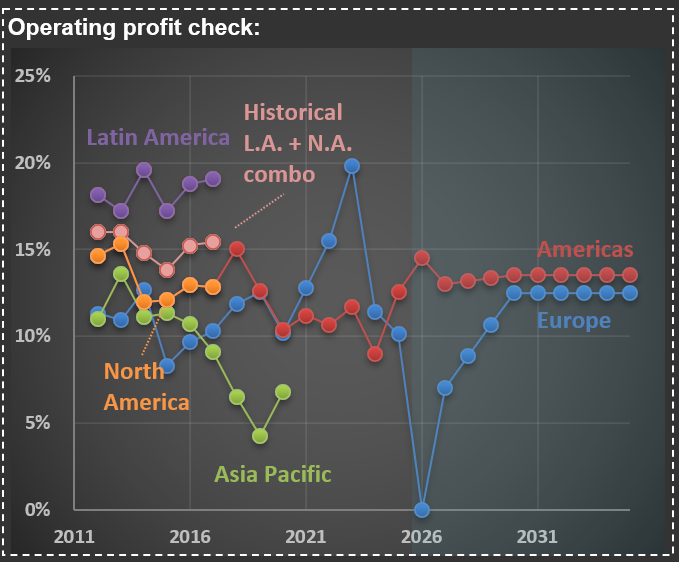
The chart tracks operating margins for every segment O-I has reported over the past fifteen years, through two changes in reporting structure. On the left you see the old geography: Latin America running in the high teens to 20%, North America in the 10%–16% range, and Asia Pacific decaying from 13% to the mid-single digits before it was sold. The lighter line marked “Historical L.A. + N.A. combo” bridges those into what is now reported as the Americas. Europe is the blue line.
Two things stand out. The first is that Europe has spent most of its recorded life somewhere between 10% and 13%. The second is the one exception — the spike toward 20% around 2022–23. That was not a step-change in competitiveness. That was hedged, favorably priced energy, at precisely the moment European gas prices were dislocating. O-I’s own guidance page tells you what happened to it: a roughly $150 million headwind in 2026 from the “energy reset” as those favorable EU contracts expired in December 2025, plus another $50–100 million of incremental energy inflation tied to the Middle East conflict.
Put plainly: the only period in which O-I’s European business earned high-teens margins was a period in which it was buying energy at prices no longer available to it. Management is now guiding to that level as the destination, in a world where the input that produced it has gone the other way.
The Arithmetic of the Promise
Suppose I take management entirely at their word. Not partially — entirely. Europe reaches 17%. The Americas simply hold roughly where they sit today, call it 15%, which requires no heroics at all.
On something close to today’s revenue base — roughly $3.7 billion in the Americas and $2.8 billion in Europe — that produces about $555 million and $475 million of segment operating profit respectively, a bit over $1.0 billion in total. Take out the $110 million or so of retained corporate cost and add back $490 million of depreciation and amortization, and you land near $1.4 billion of EBITDA. Which, incidentally, is roughly the $1.45 billion target from the 2025 Investor Day that the CFO said on this call the company still believes is achievable, just later than planned. The promise is internally consistent, at least.
Now walk it down to the owner. Cash interest runs about $340 million. Cash taxes, on that level of earnings, perhaps $150 million. Call it another $60 million for pension, the restructuring tail, and working capital. That leaves roughly $860 million of operating cash flow. Against 153.5 million shares, that is about $5.50 per share.
Capital spending is guided to $425 million this year, which includes catch-up furnace rebuilds; a normalized number closer to $385 million is about $2.50 per share. Which leaves roughly $3.00 per share of free cash flow to the owners of the business, every year.
The shares closed near $7. The company holds $339 million of cash — about $2.20 per share — against no maturities until 2028 and $1.5 billion of liquidity. Strip that out and the Market is currently valuing O-I’s entire operating business, 61 plants across 18 countries, at roughly $5 per share.
Three dollars of annual free cash flow against five dollars of enterprise value. Read that again, slowly, because it is the whole post: if management is right, the company generates enough cash to buy itself outright — at today’s price — in under two years.
I have made this argument before, in a different industry, about Charter (here). A free-cash-flow yield of that magnitude is not the price of a mature business with a soft patch in one region. It is the price of a business the Market has decided will not exist in its current form.
So Which Is It?
There are only two ways to reconcile a management team stating something like this out loud with a share price that treats it as noise.
The first is that they are Cassandra. The daughter of Priam, King of Troy, was given the gift of prophecy by Apollo; when she refused him, he could not revoke the gift, so he added a curse — she would always speak the truth, and no one would ever believe her. She saw the fall of Troy. She warned about the horse. She was ignored, and she was right. If Gordon Hardie (OI’s CEO) is Cassandra, then everything he said on that call is accurate, the market simply refuses to hear it, and $7 is one of the more remarkable prices on offer in the US equity market today.
The second possibility is less flattering and considerably more common. Executive suites are structurally poor at receiving bad news. The people who report to the CEO are the same people whose plans, budgets, and bonuses depend on the target being reached. Nobody walks into that room to say the high-teens number is not happening. In that version, management are not prophets; they are petits dictators, sincerely repeating a figure that no one around them is incentivized to contradict — right up until the quarter when reality contradicts it for them.
Readers of this blog have seen me raise the same question about Vulcan’s $20-per-ton promise (here), and about Walmart, where a CFO floated 6% domestic margins back in 2017 and the company has essentially never delivered them since (here). The pattern is not malice. It is that forecasting is hard, incentives are asymmetric, and a target announced from a stage acquires a life of its own.
What I Actually Assume
Which brings me to why this distinction, however entertaining, does not drive a single decision at RIM.
I do not forecast what a CEO says a company will deliver. I forecast what the company has delivered, across cycles, across management teams, across two decades of reporting changes — and then I ask what price makes that history worth owning. That is the discipline, and it is the reason my Whole Foods model from 2017 held up eight years later (here): I was not prescient, I was careful about what I assumed.
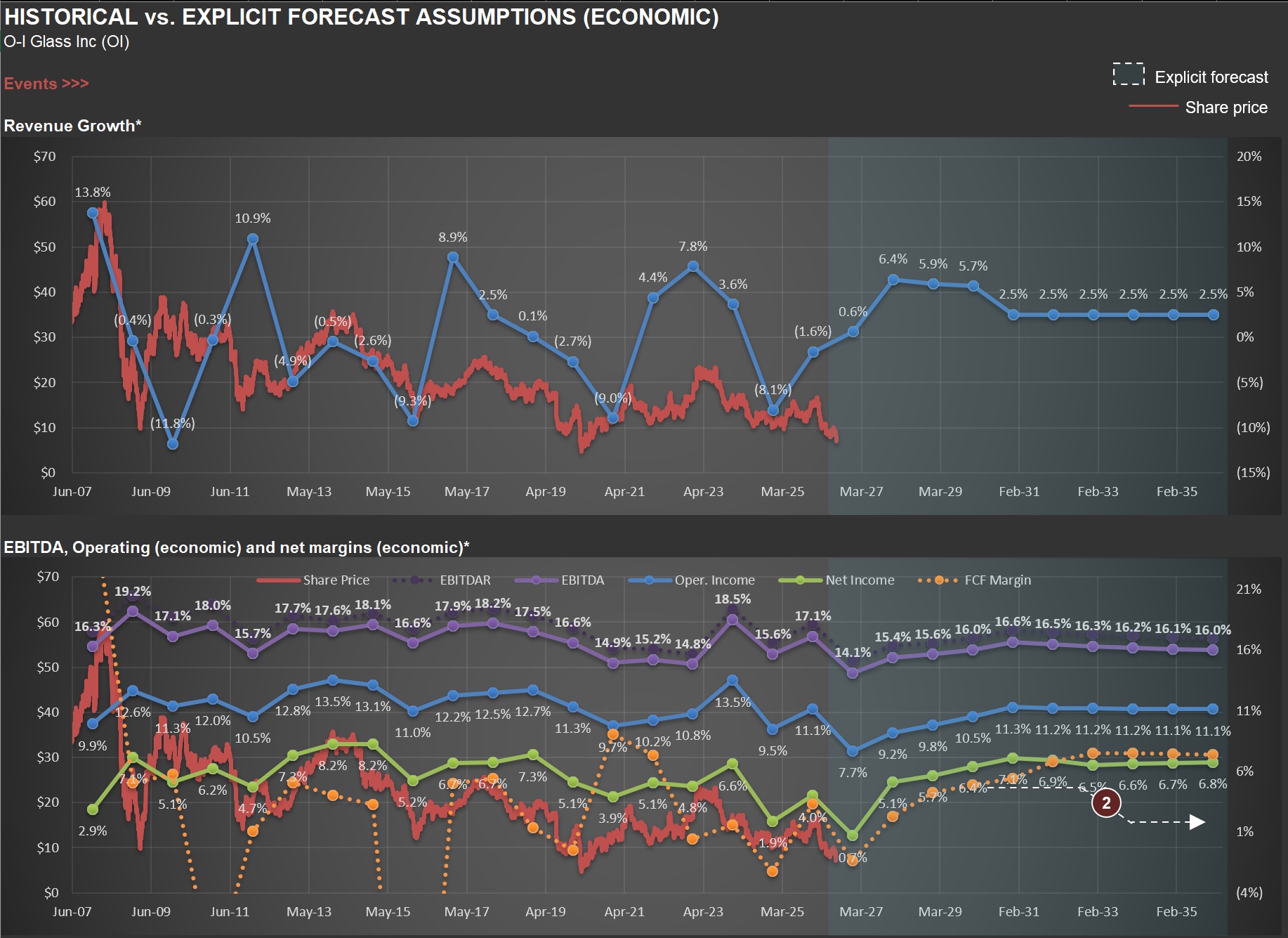
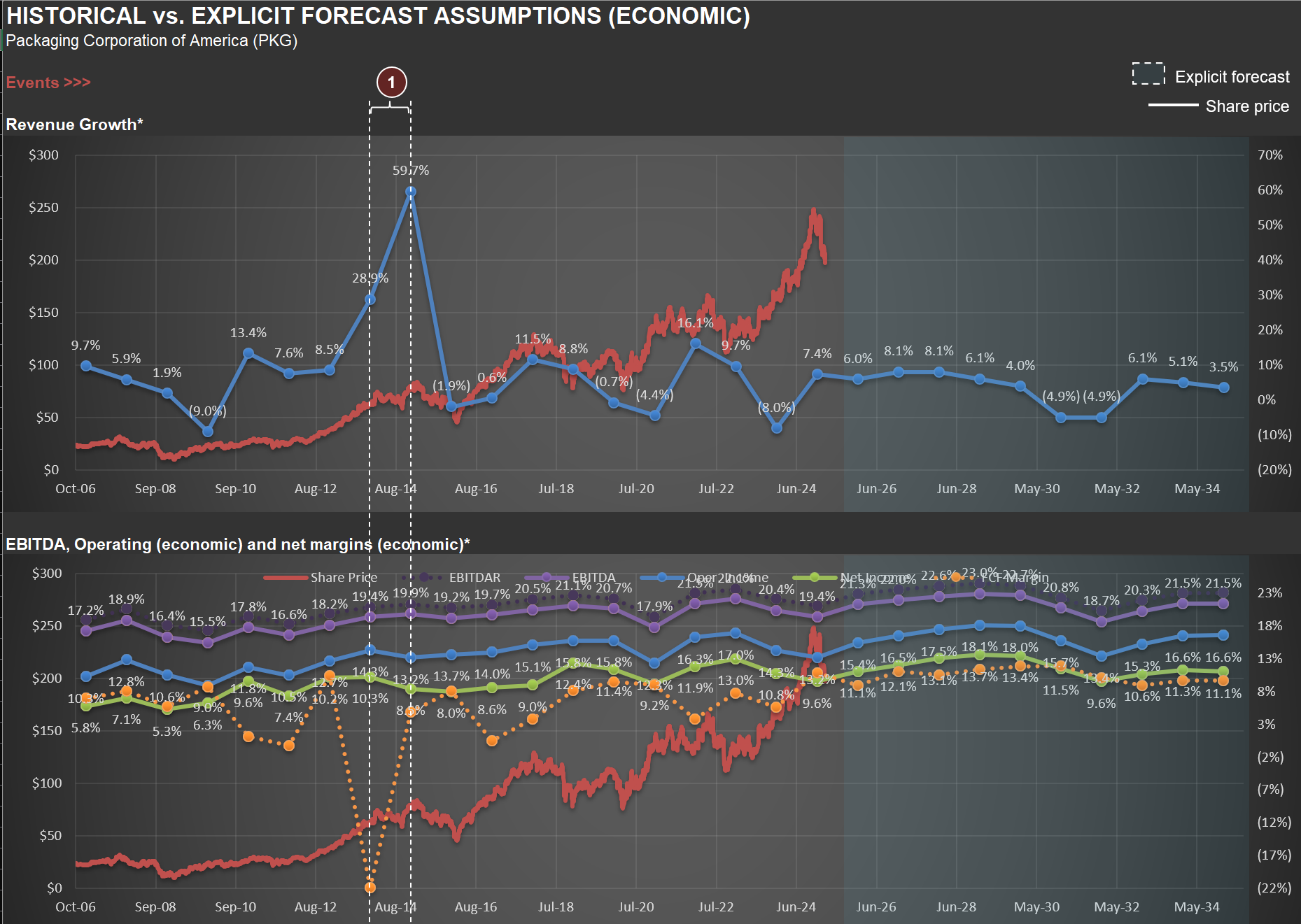
The chart below is the explicit forecast that comes out of that process for $OI. Look at what is in it, and more importantly at what is not.
Revenue growth settles at 2.5% — population plus inflation, roughly, for a mature packaging business. EBITDA margin drifts to about 16%, below the 17%–18% the company routinely produced through the 2010s. Operating margin near 11%, net margin under 7%, free-cash-flow margin in the 6%–7% range. Go back to my first chart and you will find the same conservatism: Europe recovering to about 12.5% and the Americas settling near 13.5% — in both cases below where each segment sits or has recently sat.
Now hold that against the promise. Europe at 17% and the Americas at 15% implies a consolidated EBITDA margin above 20% — a level O-I Glass has not reached in the entire span of the chart, including the pre-crisis peak. My forecast assumes the company never gets there.
And here is the part that matters. At roughly $7 per share, on those deliberately unambitious assumptions, $OI screens as severely undervalued anyway. The implied IRR (now at almost 29%) does not require Europe to reach high teens. It does not require the Fit to Win program to hit a single one of its remaining milestones on schedule. It does not require the war to end, or European gas to normalize, or the furnaces to behave. It requires only that O-I Glass go on being the somewhat mediocre, cyclical, capital-hungry glass manufacturer it has been for the last fifteen years. (For how a given IRR translates into compounded returns, see here.)
That is the comfortable place to stand. If management turns out to be Cassandra, the return is spectacular and I will have paid nothing for the possibility. If they turn out to be the other thing, I own a business at a price that already assumes they are.
I leave it to you to work out which of the two I think they are.
$VMC [Vulcan Materials]: A $20/Ton Promise—and a Few Reasons for Skepticism
Last week, Vulcan Materials hosted its 2026 Investor Day. The headline number? Management told investors they see a path to $20 per ton of aggregates cash gross profit—roughly double where they are today. Standing on the floor of the NYSE, the CEO put it this way: “just two and a half years ago, our average selling price was less than $20.” Now they expect to make that much in profit per ton.
That deserves a closer look.
The Long, Slow March from $7 to $11
Before getting excited about the next double, it’s worth remembering the journey to where they are. The picture below summarizes it nicely.
It took Vulcan roughly seven years to go from $7 of cash gross profit per ton (in the pre-housing-crisis days) to $8. That period included the housing collapse, a multi-year recovery, and a meaningful tailwind from low diesel prices. Diesel matters here—it’s directly about 10% of operating costs and indirectly much more (trucking, asphalt, plant power). The black/gray line on the chart is diesel inverted: when diesel is cheap, aggregates margins benefit, and you can see the two lines move together for long stretches.
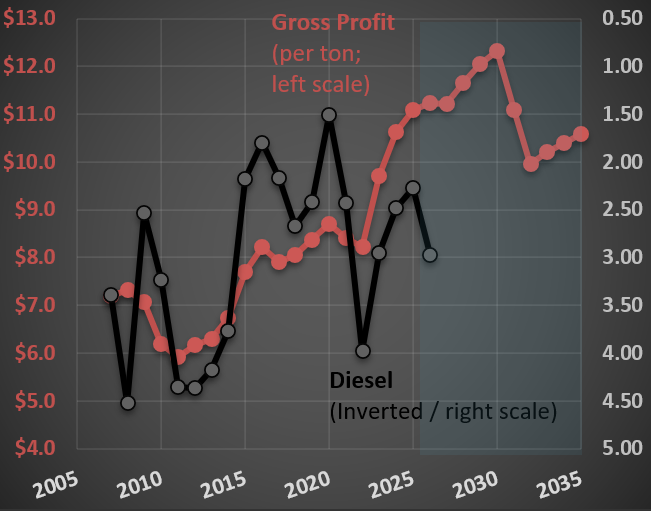
Then came the pandemic. Inflation everywhere—fuel, parts, labor. Aggregates producers responded by raising prices aggressively, and Vulcan rode that wave from $8 to $11 in just a few years. To management’s credit, they handled the inflation passthrough well. But it’s worth being honest about what drove the jump: it wasn’t structural genius—it was a once-in-a-generation inflationary environment that gave the entire industry cover to push prices simultaneously.
Now Comes the $20 Target
So what’s the path to $20? Management says high-single to low-double-digit annual growth in cash gross profit per ton, against demand growing at “low single digits.” They’ve promised more real price improvement than historical averages and lower real cost increases than historical averages. Both at the same time. The implied adjusted EBITDA roughly doubles to $4.5–5.0 billion (from $2.3 billion in 2025).
Two things make me skeptical:
First, every aggregates producer—and a few new entrants—is busy expanding capacity. Read any of Vulcan’s competitors' transcripts and you’ll find the same enthusiasm and the same playbook. When everybody and their mother is pouring capital into the same business, the historical pricing discipline that supports those margins gets harder to defend, not easier. Vulcan itself has acquired 36 aggregate operations and completed 7 greenfields in the past 3.5 years. They’re not the only ones.
Second, the demand story leans heavily on two narratives that have become load-bearing in nearly every industrial company presentation: AI and data centers. These terms came up at the Investor Day 28 times! The CEO described energy projects “to feed data centers and support the age of artificial intelligence” as a coming tailwind to aggregates intensity.
I’ve written before about why I think this is mostly a story, not a number. In this post, I showed that data center construction—even at its current historical peak—accounts for slightly above 2% of total US construction spending. The money in data centers is in the chips and servers inside the buildings, not in the aggregates underneath them. That doesn’t make data centers irrelevant to the broader economy; it means they’re nowhere near large enough, on the construction side, to move the needle for a company like Vulcan Materials.
The Familiar Pattern
This isn’t unique to Vulcan. I noted something similar with $FLS recently (here), where mentioning “nuclear” 25 times in an earnings deck added 30% to the share price for a company with roughly 3.5% nuclear exposure. The mechanic is the same: associate the business with a hot narrative and let multiples do the work.
To be fair, Vulcan is a quality company with irreplaceable assets, real pricing power in concentrated markets (while the FTC is sleeping at the wheel), and a management team that has executed well over a long stretch. Going from $11 to $20 requires some combination of (i) sustained broad-based inflation that the whole industry gets to ride, (ii) genuinely structural improvements in unit economics that haven’t quite shown up in 70 years of company history, and (iii) a demand environment meaningfully better than what management itself describes as “low single digits.”
The history of capital-intensive cyclical businesses hitting targets that depend on simultaneously beating both real price and real cost expectations is not encouraging.
Forecasting $EXP Sales: How Home Starts and Industry Behavior Intersect
Sometimes clients wonder why I devote so much time to producing (and updating) a wide array of industry-wide analyses. For example, you’ve likely seen the posts I’ve published covering the housing (here) or transportation (here) sectors. The reason is simple: industry dynamics are typically the critical force shaping sales for any individual company.
Take today’s focus: $EXP (Eagle Materials), a leading U.S. producer of wallboard and cement, with additional operations in concrete and aggregates. See the first scatter plot. 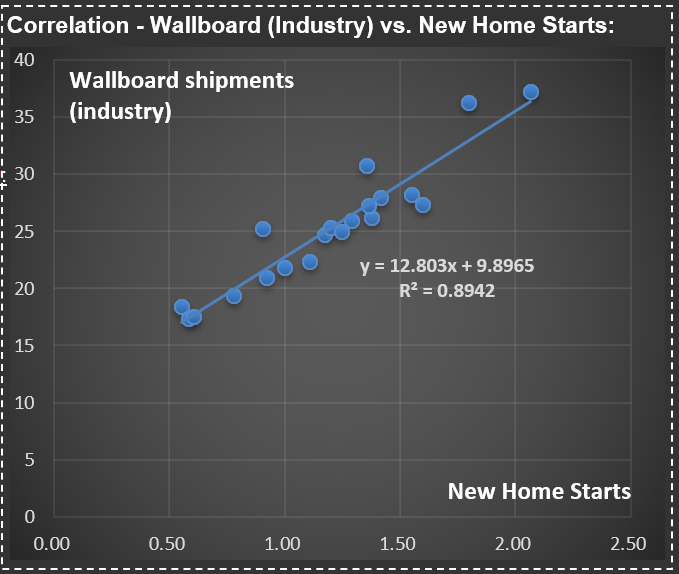 It highlights the strong correlation between U.S. wallboard sales and new home starts (that is, newly constructed houses). While not all wallboard goes into new housing, this single variable explains nearly 90% of total sales, reflecting the interconnectedness of adjacent areas within the housing complex.
This is why understanding the cycles of new home starts in the U.S. is essential for accurately forecasting sales for Eagle Materials’ wallboard segment. From there, it’s a straightforward process to estimate $EXP’s market share and, with further analysis, explore the dynamics between capacity utilization and wallboard pricing—take a look at the second chart for a visual depiction. 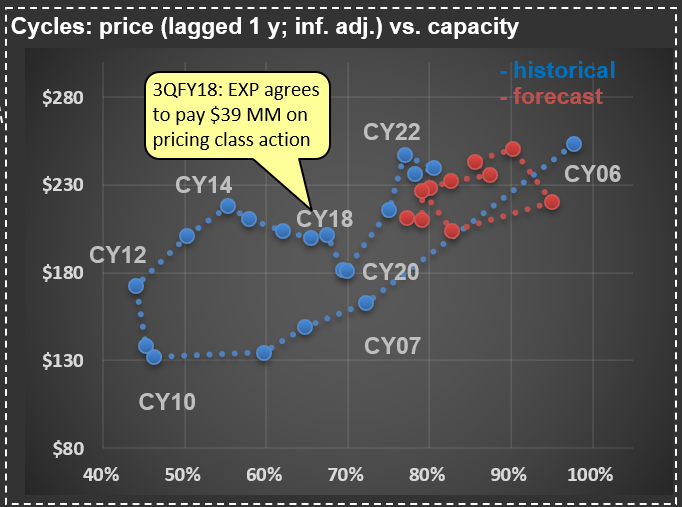
During the mid-2000s housing boom, capacity utilization at $EXP and its competitors reached very high levels (as did the price of wallboard). As the cycle turned and housing starts collapsed, utilization rates dropped—and prices followed. Then, something unusual happened: in the early 2010s, wallboard prices climbed sharply, even though the industry’s fundamentals seemed weak. For a while, my analysis questioned its relevance—until, almost a decade later, Eagle Materials (along with USG, the market leader) was fined tens of millions of dollars in a class action for price-fixing. In short, the major players had been colluding.
Looking ahead, pricing should remain relatively disciplined, especially with fewer homes expected to be built in the coming years (see my recent analysis on U.S. Census Bureau data and future new home starts - here). That said, if significant industry players resume collusive behavior, all bets are off—so I’ll be keeping a close eye on price developments in this segment.
Navigating Cycles: Insights from $OLN’s Volatile Industry
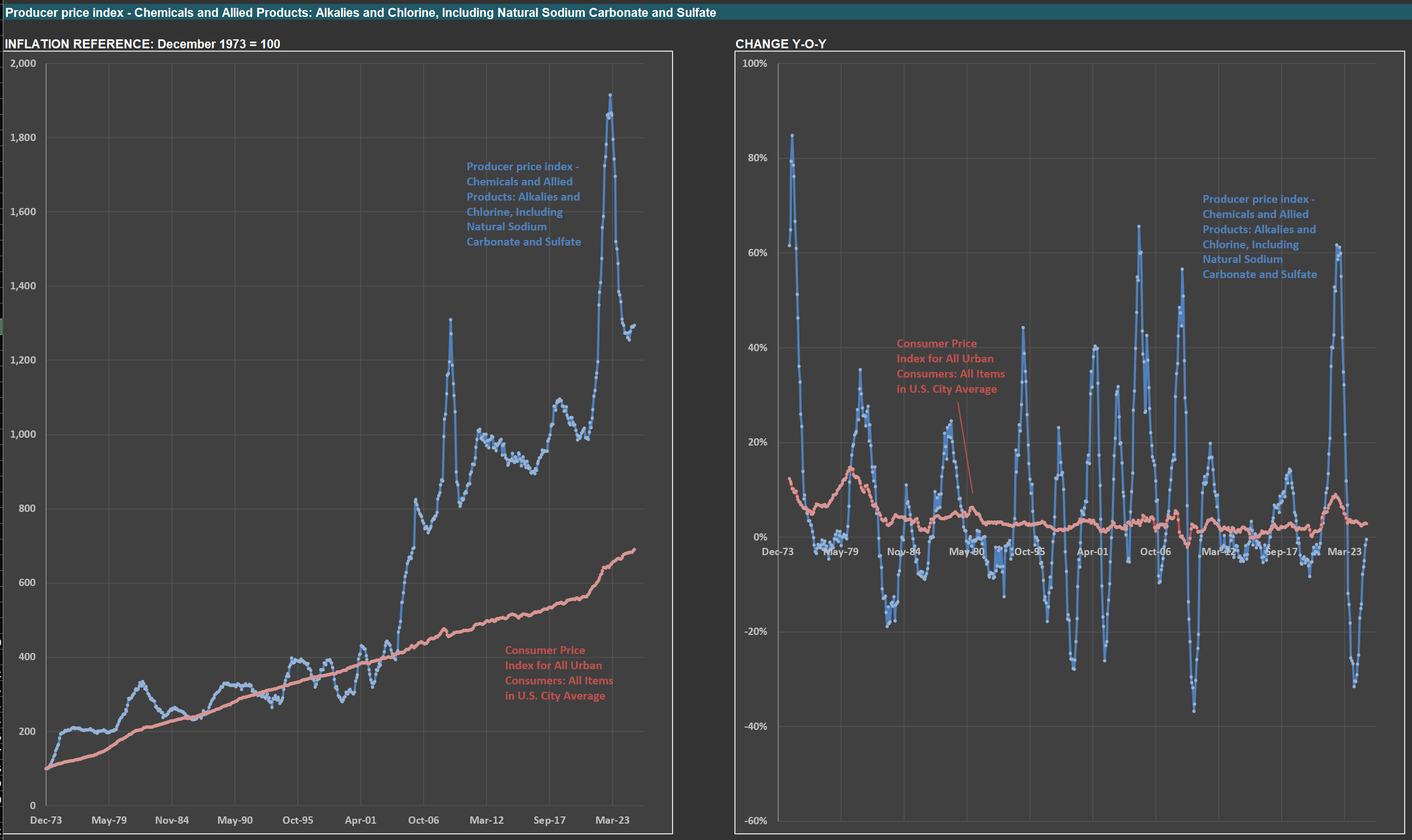
Today, I’m analyzing $OLN (Olin), a company specializing in chlorine, caustic soda, vinyls, and other chlorinated organics, as well as epoxy materials and their precursors. The charts below illustrate the challenges of operating in a cyclical industry—and what that means for investors.
On the left, you’ll see a price index for alkalies and chlorine (in blue), $OLN’s core product category, alongside a broad consumer price index (in red). On the right, the year-over-year changes for both series are displayed. The stark variability in commodity prices compared to broader price indexes is evident. The most recent spike was driven by two factors: heightened consumption during the pandemic—fueled by oversized government stimulus—and a fire at a major U.S. plant producing similar chemicals.
This volatility highlights how challenging it is to manage a business in such an environment. For investors, however, there’s an upside. These sharp price and volume swings can significantly impact $OLN’s profitability, leading to fluctuations in EPS and stock prices. For those willing to put in the work, these cycles create opportunities to buy or sell with a meaningful “margin of safety.” Of course, understanding these dynamics requires careful analysis and a great deal of patience.
$SEE’s Product Care Segment: A Warning Sign and The Market's Overreaction
$SEE (Sealed Air) is a name you’re likely familiar with, even if you don’t realize it. They’re the company behind Bubble Wrap—the iconic packaging material that’s as fun to pop as it is practical. Beyond Bubble Wrap, SEE provides materials and machines that streamline packaging processes across industries. If you’ve purchased food or products recently, chances are they were packaged using SEE’s solutions. You can find more examples of their offerings on their website.
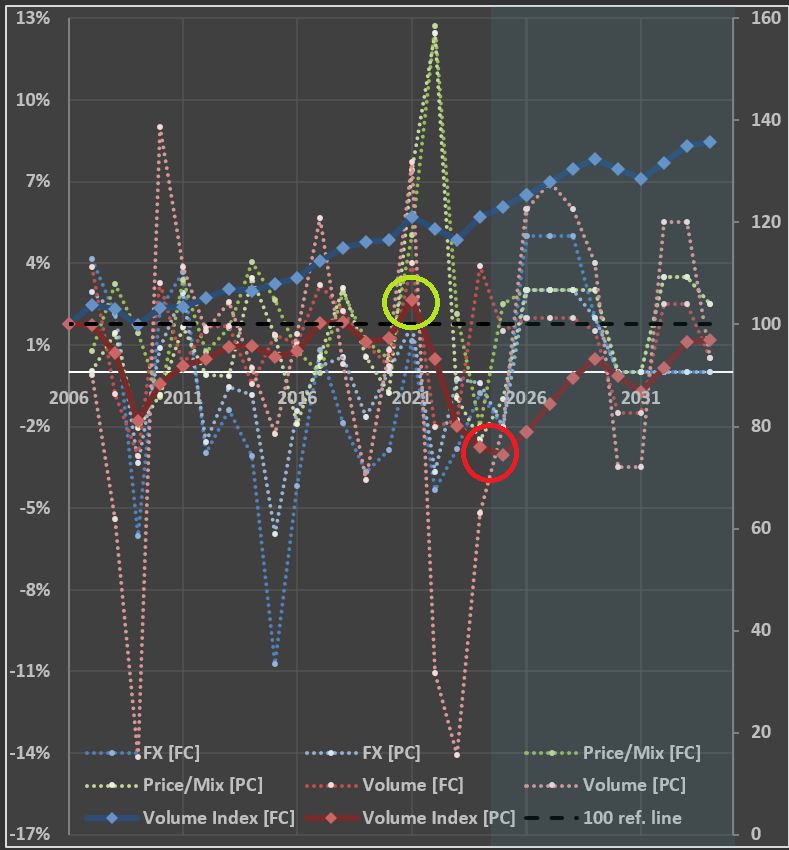
Take a look at the chart below, which breaks down key metrics for SEE’s two segments: Product Care [PC] and Food Care [FC]. The dotted lines represent the impact of volume, price, and foreign exchange (FX) on sales. Meanwhile, the solid lines show cumulative volume indices for both segments (2006 = 100).
The blue line for Food Care reflects stability—no major surprises there. But the dark red line for Product Care tells a different story. After recovering from the lows of 2009, there was a modest uptick in 2021 (highlighted by the green circle), driven by pandemic-era stimulus. However, the red circle draws attention to concerning figures for 2024 and projected 2025. The index for Product Care volume is around 75—25% below its 2006 level (two decades ago) and even lower than the 81 seen in 2009.
This decline raises important questions. Packaging products and equipment is undoubtedly a competitive space, but SEE remains a key player in the industry. The drop in Product Care volume seems less likely to stem from a sudden loss of market share and more likely to signal broader economic trends—perhaps another indicator of a consumer recession. Despite this, the market appears to have punished SEE’s valuation, focusing narrowly on its current depressed earnings per share (EPS). Could this reaction be overly pessimistic?
Where Did the Cash from Operations Go?
Today, I’m diving into my analysis of $PKG (Packaging Corporation of America), a company that offers an interesting case study in how businesses deploy their cash beyond dividends and share buybacks. One common strategy is acquiring other businesses, typically within the same industry. This approach aligns with the broader trend in the U.S., a country I often refer to as “the land of oligopolies,” where many industries are dominated by a handful of major players. However, not all acquisitions are created equal—some management teams venture outside their area of expertise, attempting to diversify into uncorrelated industries. These moves frequently result in losses.
In contrast, PKG’s management opted for a more logical and focused strategy. In late 2013, they acquired Boise Inc., another paper and packaging company, for $1.3 billion. Since then, PKG has made additional acquisitions within its core industry, albeit at smaller scales.
The two charts below illustrate the impact of the Boise acquisition on PKG’s financials. The first chart highlights a notable surge in sales growth over the two years following the deal’s closure. This increase reflects the integration of Boise’s sales into PKG’s financials. The second chart shows a significant negative Free Cash Flow (FCF) margin during this period. FCF margin is calculated as (i) Net Cash from Operating Activities minus (ii) Net Cash from Investing Activities, divided by (iii) Sales.
The $1.3 billion spent on Boise is captured under “Net Cash from Investing Activities” pushing the total figure into negative territory. The key question is whether this acquisition will ultimately pay off—a question that demands detailed valuation work. After assessing the rationale behind a deal, it’s essential to adjust future projections to account for the new assets and business operations.
Getting this process right increases your chances of buying or selling a company at prices aligned with your investment thesis—whether long or short. Missing critical details or skipping a robust forecast can lead to mediocre performance at best. And if you happen to make money despite a flawed forecast? Recognize it for what it is: luck.
At its core, the job of an investment manager is to minimize reliance on luck by rigorously analyzing and projecting logical outcomes. Yet even when your analysis is spot on, patience and discipline are vital—it can take years for your thesis to play out fully.
Fundamental Analysis Spotlight: $OI and Market Mispricing
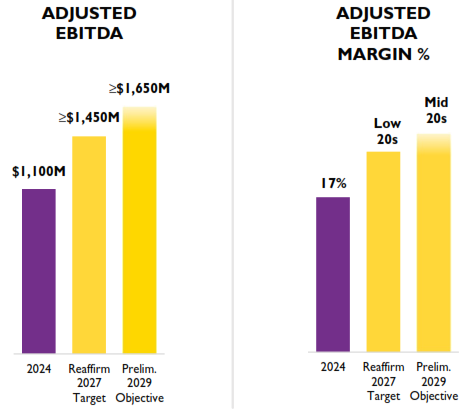
I attended the $OI (OI-Glass) investor day event and wanted to share some interesting insights. Look at the first chart below, which I pulled from their extensive 91-page presentation. Notice the projections for 2029: management targets EBITDA margins in the “mid 20s,” so let’s call it “around 25%.”
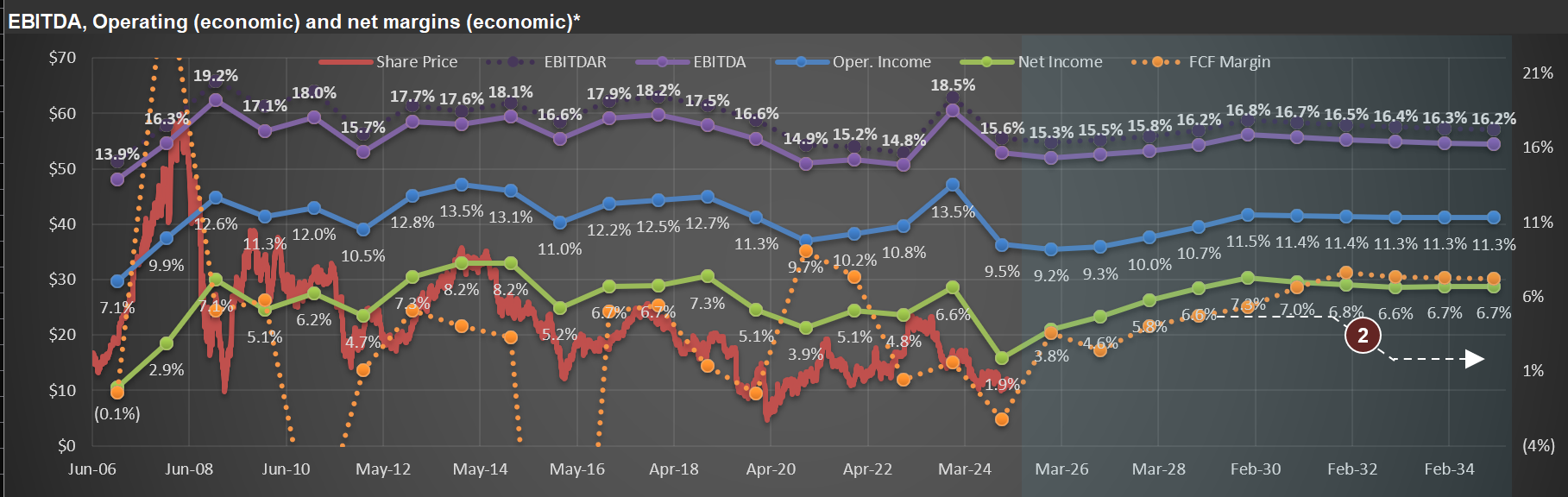
Now, check out the second image—this one shows my base-case scenario for OI-Glass. By 2029, my estimated EBITDA margin stands at 16.8%. I’m slightly more conservative in calculating EBITDA than management, as I leave some expenses on my calculations that they might exclude. So let’s round up my estimate to 17%.
But here’s the impressive part: OI-Glass appears substantially undervalued even using my conservative margin of 17% (or 8 percentage points below management’s target). Historically, the market has valued companies similar to OI-Glass—assuming my base-case scenario—at around 4 to 5 times today’s valuation. It would be much more with EBITDA margins of 25%!
This is a perfect illustration of market inefficiencies. The market isn’t fully pricing future profitability improvements implied by OI-Glass management’s expectations. Instead, share prices often reflect current EPS disproportionately. This is precisely where fundamental analysis adds value. If you’re skilled at (and have the time to dedicate to) understanding businesses and accurately forecasting long-term earnings potential, you’ll be well-positioned to identify opportunities (long or short) that eventually get recognized by the Market’s mechanical pricing heuristics.
Hence, I focus on first understanding what companies do and in which context (e.g., their competitive environment). Only after that do I spend time modeling a company in excruciating detail (also a necessary step to quantify your understanding of the business). With such an approach, I hope to be an “investor” and not a “speculator " (who blindly hopes that share prices move in their favor).
Glass Half Full: OI's Strategic Pivot Promises Value Amid Historic Low P/E
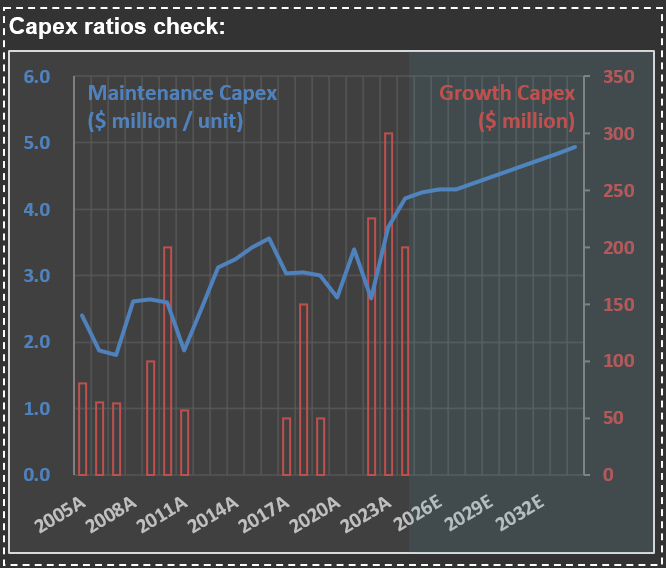
Never underestimate how much money CEOs can burn (and still be paid millions to do so!). Below is my check for Capex for $OI [OI-Glass], the biggest glass containers manufacturer in the world. The company battled massive asbestos liabilities for years. When that got solved, what was the prior CEO plan? Burn almost $1 billion (these are the sum of the two last groups of the red bars) in a new technology called MAGMA.
Here is what the new CEO just said about it: “With regard to MAGMA, we continue to ramp up production at our first greenfield line in Bowling Green, Kentucky. The achievement of key operating and financial milestones at this site over the course of 2025 will be critical as we chart the future of the MAGMA program. As we focus on these milestones at Bowling Green, we have paused the development of Generation 3. As with any capital project, MAGMA will be required to generate returns of at least WACC plus 2%. We will provide more details on our long-term strategic plan next month at our Investor Day.”
In other words, MAGMA didn’t work (as I’m assuming it doesn’t generate returns above WACC). So I will be in New York on March 14th - at the NYSE - to participate on the company’s Investor Day. I hope they will provide information that will increase investors confidence. As of now, if they achieve their $1.45 billion EBITDA guidance for 2027, it means that the company is trading at less than 3x P/E! I don’t use multiples to calculate fair values for companies at RIM. But such a low figure called my attention!